Published on 2025-06-16 by Skylar Strudwick
Holocaust Survival

In early April of 2025, I walked through the Washington D.C. Holocaust Memorial Museum. Silence echoed through the dimly lit hallways, and the walls bore names and dates of lifetimes cut short. Testimonies, photographs, and newspaper clippings hung on the wall, stretched out to the museum-goers like ghosts shouting warnings to everyone walking past. As an Ashkenazi Jew, the experience was not simply a historical account but a personal tale of one of the most devastating periods in Jewish history. It was a personal experience walking through the museum knowing that I carry this legacy, but throughout my visit, it became clear to me that this remembrance cannot end in silence; it has to elicit urgency.
A common phrase that came out of the Holocaust is "Never Again," but what does that mean? Does it mean that Jews should never again face genocide, or that no group should ever be sentenced to the cruelty that Jews were subjected to while the world watches? If "Never Again" is not just a slogan, what is it? I believe that "Never Again" is a demand, and that demand is failing our world’s refugees.
The Refugee Crisis
Across the world, from Sudan to Afghanistan, Syria to Myanmar, millions of people are fleeing persecution, war, and instability. They're seeking safety as a means for survival, but the world—Europe and the United States in particular—is not responding to the calls for refuge or the cries for help. They've put up barbed wire and fences where borders used to call out with open arms and speak as a place of hope. Bureaucratic protocols have snuffed out compassion. People are drowning in the Mediterranean Sea while nations' leaders debate tax reforms and quotas.
Jewish Refugees in the 1900s
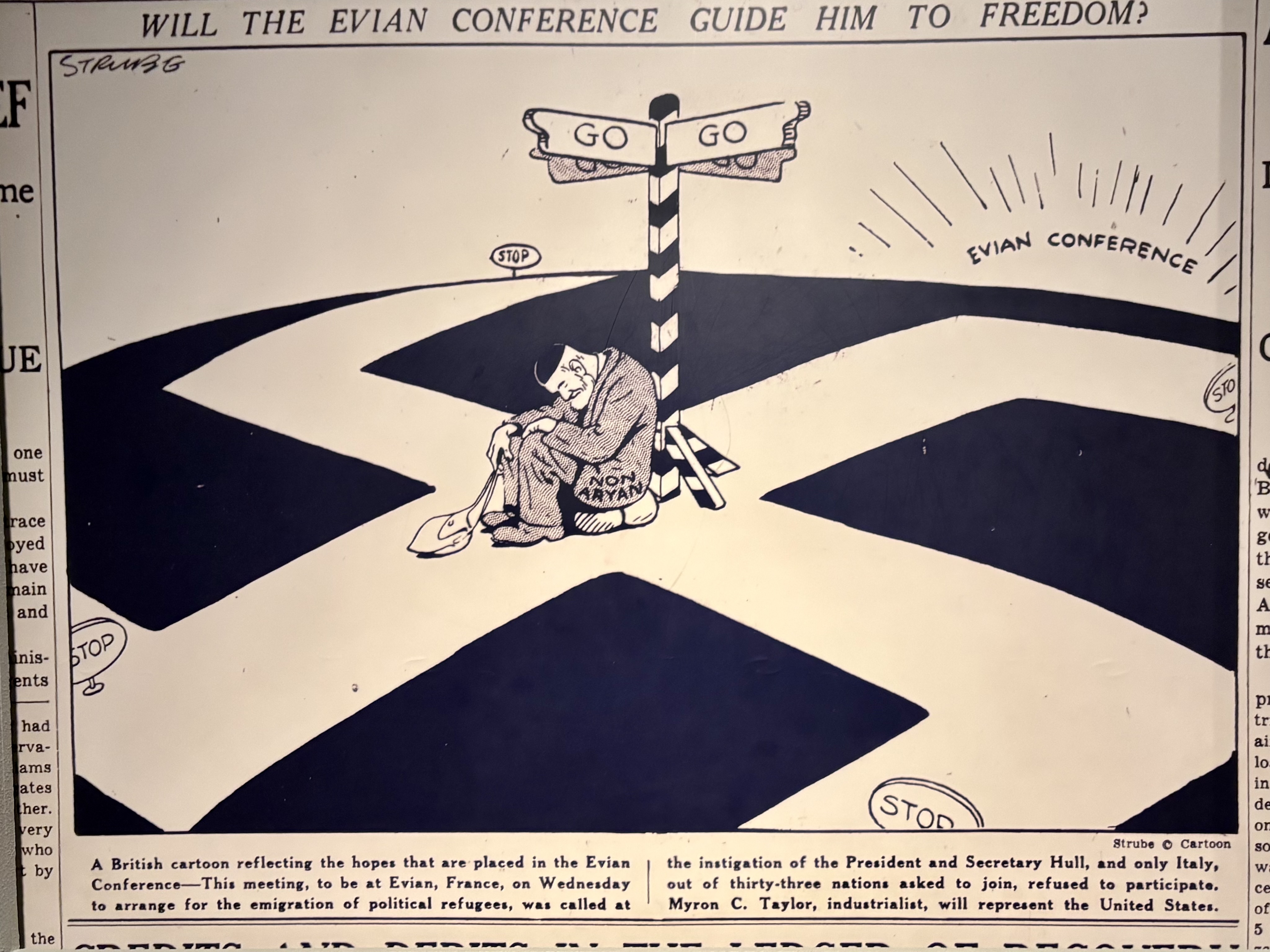
The plight of Jews fleeing Nazi Germany directly mirrors the refugee crisis of today. In the 1930s, many Jewish people were refugees across Europe after being turned away from various countries that claimed to be havens for human rights and human values. Once the Holocaust ended in 1945, an estimated six million Jews were dead, but hundreds of thousands of people survived with no home to return to. Entire towns in Eastern Europe were slaughtered. In places like Poland, anti-Semitism remained

deadly, with pogroms targeting surviving Jewish communities in the years directly following the Holocaust.
Many survivors lived in displaced persons camps in Germany, Austria, and Italy under the Allied administration. The camps were overcrowded and underfunded, but immigration options were still limited. Quotas in the United States remained strict, and Britain restricted immigration to Palestine, which was under British rule at the time. Between 1945 and 1952, about 250,000 Jewish refugees resettled in the United States, Canada, and what would later become known as Israel in 1948. Jewish refugees were given sanctuary in Israel, Europe, and the United States, but where has this generosity gone for other groups of refugees?
Today, the United States has put travel bans into effect, banning people from countries like Afghanistan, Myanmar, and Somalia from entering the United States. During the ongoing Myanmar civil war, people seeking refuge in the United States are turned away in their need for sanctuary. The United States should show benevolence to all immigrants and refugee groups. Banning travel and denying refuge to anyone is a threat to all because it erodes the universal principles of safety and equal human worth that protect us all in times of crisis.
Holocaust Remembrance as a Means of Survival
The refugee situation of today is not identical to that of the Holocaust. But history does not need to repeat itself precisely for the lessons learned in the Holocaust to translate to today's world. The Holocaust is a strong example of the devastation that happens when the world turns a blind eye to persecuted people pleading for help. Refugees are not to be seen as a burden, but the human face of our global responsibilities.
Remembrance means nothing if it is absent from empathy that stretches beyond one's community. The Jewish people hold painful memories of what happens when countries close their borders and shut their doors, when “not our people, not our problem" becomes national policy. The memory of the Holocaust gives us a responsibility to not just remember our own, but to speak up for and stand against cruelty today. Selective solidarity is not an option.
Memory and Action
Holocaust education is importantly focused on the memory of all those killed in the Holocaust. But I believe that the sentiment of "Never Again" serves as a global call to action. Learning about the Holocaust does not need to only focus on grief, but can also focus on action, including calls for borders to remain open to those who need it. "Never Again" is not only about the Jewish people, and it never has been, and it should not be. "Never Again" is also about refugees and civilians under constant attack. About people whose stories cannot be shared and archived in museums because their conflict and fight for survival is ongoing, such as Palestinians in Gaza.

Never Again
We remember what was lost, and we mourn what will never be. The remembrance of the Holocaust does not need to end merely in mourning, but can live as a call to action for everyone to stand up against the treatment of the world's refugees today. That is how we keep the memory alive. This is how we ensure that "Never Again" means never again for anyone, anywhere.
The views, thoughts and opinions expressed in this blog are the author’s only and do not reflect an official position of the University of Minnesota, the Human Rights Program, or the College of Liberal Arts. As an institution of higher education that values and promotes free speech, civil discourse, and human rights we welcome a variety of perspectives and opinions from our student contributors that are consistent with these values.

Skylar Strudwick (CLA '26) is a junior currently pursuing a double major in Psychology and Sociology with a focus on public policy and human rights. She serves as a member of the 2024-2025 Human Rights Program Undergraduate Working Group. Outside of the Working Group, Skylar is also a Pre-Law Society mentor, CLA Student Board Council member, and Treasurer for FUSE. She is passionate about community outreach in the Jewish community and holds a particular interest in genocide studies, women's rights, and Jewish studies.